Maxim SHALYGIN: Becoming the Ocean
- 26 трав.
- Читати 16 хв
In the antique tradition, the Great Ocean encircled the entire known world — the ecumene — and embodied the imperishability of primal elements. For the renowned visionary composer Maxim Shalygin, the ocean serves as a metaphysical symbol of universal unity. In his work, he blends the poise of classicism with a subversive deconstruction of the "Western canon" with equal ease, moving naturally from the liturgical resonance of sacred music to the weightless aporias of modernism.
There is no conflict here: beneath the surface contradictions lives a singular "oceanic feeling" of primordial wholeness that feeds human imagination in the twilight of our exhausted post-theistic era. In a sense, Shalygin’s music eludes critics because it effortlessly outgrows their legacy analytical tools. One thing is certain: through his art, the composer transcends the various metamorphoses of isolationism—cultural, linguistic, and social boundaries, as well as the "chronological provincialism" (to borrow C.S. Lewis’s concept) of our time—leading us toward an almost Whitmanesque universalism, joy, and catharsis.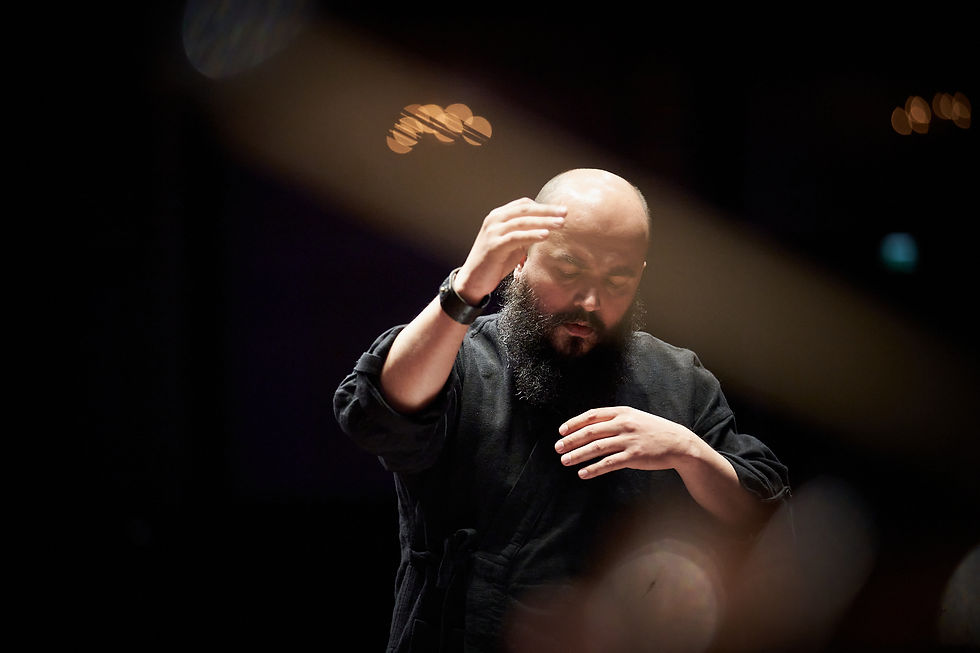
With stoic ruthlessness and Montaignean irony, Maxim Shalygin spoke to Nezaležnist about the artist’s place in a world where postmodernism has dismantled old hierarchies, "equality has become more important than talent," and concert hall programmers no longer search for new geniuses.
Mykola Ivanov: There are composers who, like Mozart or Schubert, discovered their calling exceptionally early. Yet there are others, like Bruckner or Borodin, who arrived at it relatively late. How did this unfold for you? Which events of your childhood, and which milestones of your subsequent external and, above all, internal biography, exerted a decisive influence on the formation of your mature creative phenotype?
Maxim Shalygin: I find it difficult to speak about "recognition" today in the conventional sense of the word. Simply because interest in new music is so minuscule that even if a composer is deemed recognized today, in 99% of cases this is confined to a highly insular circle of professionals and aficionados of contemporary music. It seems to me that few people today, if anyone at all, believe in the hypothetical possibility of a new composer emerging at a level comparable to the established classics. Sometimes I suspect contemporary composers themselves do not believe it. And if someone at a new music concert catches a glimpse of such a thought, they treat it more like an anomaly, a system glitch with no real consequences.
To put it more plainly: artistic directors of concert halls are not looking for new geniuses. Equality in every sense has become more important than talent; curatorship, in the best sense of the word, has vanished from musical life. It has devolved into servicing foundations which, in turn, were supposed to service art—but something went askew.
Conductors and musicians are consumed entirely by the classical repertoire, because many believe that only within it can they measure themselves against the great interpreters of the past and leave a mark on history. There are listeners searching for something fresh and authentic, but they are left to the mercy of algorithms and are rarely able to forge a path through the jungle of faceless compositions. Often exhausted by these attempts, they gladly return to the safe harbor of the familiar classics. This is not a complaint; it is a realistic picture of the contemporary musical world in simplified terms.
Taking my specific case: I am one of those fortunate composers whose music people want to hear and musicians want to play. Yet even in this seemingly ideal situation, we discover that halls refuse to program it, most often guided by an a priori assumption of poor ticket sales.
Here you might counter by bringing up Pärt, Glass, Lang, and a few other household names. But I am afraid I must disappoint you. Had their music not fit so perfectly into the film industry, many of their current fans would hardly know they existed, and they would be consigned to oblivion alongside the music of Lunyov, Smolka, Szymański, Furrer, and many other outstanding authors of our time. In other words, serious new music appears to people as an optional luxury—something permitted to exist, but utilized reluctantly.
MI: You were born in the industrial city of Kamianske at the eclipse of the Soviet era—a complex period marked by the "energy of decay" of the Soviet Union. How does your local identity coexist with your broader Ukrainian and European identities? What metamorphoses does your self-awareness undergo in emigration?
MS: Once, I was standing at a bus stop near the Dniprodzerzhynsk Metallurgical Plant in my hometown. Before twilight, the sky blazed with the sun on one side and was illuminated by pouring, molten metal on the other. Drunk workers were leaving the factory, the asphalt was riddled with potholes, puddles reflected the glow, a vile chanson blared from the newspaper kiosks next to pornographic magazines flashing their covers, the stench of the plant mingled with blossoming trees, my bus was nowhere to be seen—and I thought about how incredibly lucky I was to live in art. I realized I could connect to any era without borders, investigate the structural secrets of Scarlatti’s scores, pull a volume of Guillevic from my bag, or bury my nose and lose myself in a book of Munch reproductions. And that is not a metaphor. I live inside art, so I do not feel like an émigré, no matter where I am.
MI: For more than a decade, you have been living in the Netherlands. Quite often, even after deep integration into a new society, a person remains in a peculiar kind of isolation. Living in the heart of the British metropolis, London, T.S. Eliot wrote in a letter to a friend: "Remember that I am a metic — a foreigner." The Greeks used the term metics (metoikoi) to describe resident aliens who lived in the polis but bore the stigma of foreignness. Tell us about your relocation and your experience of emigration. Have you managed to become "one of their own" during this time?
MS: I am fundamentally indifferent to this question because wherever I go, I always encounter talented and exceptional people, and I am glad for every such meeting. For me, the specific territory I occupy is of no foundational importance. But I can say one thing with certainty: in the Netherlands, up to this point, I have managed to realize almost all of my creative designs. If any of them have remained overlooked, it is mostly due to my own shortcomings. We shall see what happens next, because today it is becoming increasingly difficult even here to find funds and opportunities to realize my ideas. Yet for now, I am surrounded by people who believe in what I do and help however they can.
With that same admiration, I look at people in Ukraine today who, despite everything, perform my music and do so with incredible selflessness and love. My task is to create a precedent through art, during the experience of which people can draw closer, shed their constraints, and feel who they truly are—to feel the beauty and diversity of the world and of themselves.
MI: In your view, what are the primary differences between the Ukrainian and Dutch cultural mentalities? Despite the fact that Ukraine gave the world the Kyiv avant-garde school, the Ukrainian music scene on the whole remains rather conservative and paternalistic. How can we overcome this state?
MS: It is difficult for me to make such generalizations because I lack sufficient expertise in this domain. However, I believe it is vital to pay attention to talent—not to let gifted individuals slip by unnoticed, and to support them by all possible means. Talented composers are born quite rarely, and in my view, it is a profound failure not to perform their music, especially when they are working somewhere nearby, refining their craft and sensibility.
Regrettably, it is precisely what is close at hand that is hardest to recognize as a miracle. For us, a miracle is something unapproachably distant. We often require a great deal of time to appreciate it. But it is essential to perceive it and not turn away. Because by looking at the world through the prism of art created by truly talented people, we gain the opportunity to acquire keys that can unlock genuinely wondrous worlds.
MI: Your music almost always features motifs from grand cultural themes. These are constant references to the "Western canon"—the ancient tradition (Odysseus, Helios, Thracians) or liturgical Byzantine and Catholic spirituality (Marian Antiphons, Agnus Dei). How important are cultural and religious contexts to you?
MS: Some pieces are written to commission, so the themes may be proposed by the project creators. This was the case with the ballet Odysseus and the Marian Antiphons. However, since music is the most abstract of arts, the theme itself does not carry immense weight. For instance, if I hadn't told you that a piece was the Marian Antiphons and simply played the music, you would hardly be able to guess the title, even approximately. But in retrospect, when analyzing music close to us, we tend to explain things to ourselves verbally, especially if a work carries a program title.
At the same time, one cannot dismiss the influence of a theme on the musical material. This is particularly true when encountering text within a musical composition. Here everything becomes more intricate, because the musical matter begins to vibrate at its junction with poetic matter. The amplitude of how much the vectors of their vibrations align or diverge provides us with nourishment for the creation of additional, tertiary meanings.
I was never a child who read voraciously, but from childhood I was immersed in the cultures of various nations through different mediums. Since then, I continue to discover new things in world culture that sometimes directly or indirectly influence me. Occasionally, the choice of a theme or title comes instantly, but often it surfaces after the music has been composed, in retrospect. I recently wrote Canto Paradiso for choir and orchestra, and it so happened that I wrote the entire choral part without text—this happens to me sometimes. When I had nearly finished the work, I realized that text would have to be set to the music. I enlisted my friend Oleksandr Sushynskyi, and after several weeks of intense work, he created a magnificent poem that perfectly matched the musical idea and meter.
Although music is a temporal art form and often manifests to us linearly, flowing from point A to point B, non-linear things occur during its creation. Pieces that we listen to in a single breath might have taken several years to create, with interruptions, reorderings of movements, the replacement of initial meanings with others, and so on. In this sense, music is almost like love: few understand anything about it, yet everyone wishes to experience it.
MI: Recently you wrote your first opera, Amandante. Its libretto is based on Plato's Symposium, one of the foundational texts in the history of Western civilization exploring the nature of love, which is traditionally considered virtually impossible to stage. The first attempts at its creative musical interpretation belong only to the modern era, undertaken by Satie and later Bernstein. How did you resolve to take such a bold step?
MS: What could be better than tackling an impossible task? I have several works whose subjects were daunting to approach. Strangely enough, this was not one of them. The Symposium was proposed by the commissioners of the opera, Nova Opera, and I agreed without hesitation. Despite this, the history of its creation was tortuous and complex. I will focus on just a few moments.
I realized immediately that I did not want to use Plato's text in its raw form. I called my friend Paul van der Woerd and suggested he write a libretto based on Plato's text, but in poetic form. This was a challenging task in itself, but the situation was further complicated by the fact that Nova Opera consists of four vocalists, whereas the characters in the Symposium, as you recall, number nearly twice as many. Furthermore, there are no female characters in the original text, and we absolutely required two sopranos.
Paul came up with a brilliant concept. He introduced Agathon's wife and the Flute Player — who are simply dismissed from the banquet in the original text—and made them central figures who comment on the events. We also faced difficulties in realizing the image of Diotima, whose words are delivered through the mouth of Socrates. For this, we devised an interesting solution where Socrates’s part functions as a kind of shadow of Diotima. In short, a job I likely should have finished in a year stretched into three.
On one hand, Paul created a highly poetic and accommodating text, but on the other, he presented me with demanding challenges, and their intensity mounted as the plot advanced. Reading the libretto and arriving at one of the pages, I saw only the words: "Fuck, fuck me, fuck you"... And so it went for the entire page. It took me long months to understand how to solve this riddle. But when I found the musical solution, I literally jumped around the room with joy.
I wanted to write an opera that would have no "filler" scenes and would simultaneously consist entirely of melodies. Consequently, a vast amount of time was spent searching for the most natural transformation of text into music. Strange as it may seem, naturalness of development is perhaps the most difficult thing in art. When an impression is created that the material grows of its own accord, it leaves the listener with a sense of the unvarnished and unmanufactured, dissolving the barrier of distrust toward the author and piercing straight to the heart. Such music is arduous, almost impossible to write, but when faced with such examples, it is difficult for any of us to resist.
MI: Your music frequently employs numerical symbolism and deploys new musical instruments. What place does creative experimentation occupy in your work?
MS: When I first began composing, I was fascinated by the ideas of numbers in music; the concept of the mirror also captivated me for a long time, as did many other concepts from science or related arts. However, I quickly realized that technology in itself is not as important as the necessity of mastering it to capture an image with the utmost precision. Therefore, experimentation as such, in my view, should remain in the laboratory, and its result should be brought to the stage.
As it happened, I actually had to work with instruments invented specifically for my piece. This was largely my own initiative, which ultimately turned into a rather painful experience. We spent several years working on this piece—SEVERADA for nine cellos and 25 motor-controlled instruments. But in the end, after a successful tour, the inventor of the instruments decided to dismantle and repurpose them for something else, making it practically impossible to perform the score in its original form. Of course, it is entirely possible that someone will replicate these instruments one day, perhaps even in an improved form, or that I will find the strength to rewrite the piece for orchestra. Or perhaps not.
It seems to me that I resort to this kind of experimentation most often because I have ideas and a desire to write grand works for large ensembles, but the opportunity to do so is, unfortunately, almost non-existent. And since life is short, I want to realize my ideas at least in this form. Thus, you could say I am sometimes an experimenter by compulsion.
On the other hand, there are times when I feel it necessary to introduce non-musical sounds into the musical fabric. For instance, in SEVERADA, the voice of an infant sounds, which in the coda echoes the cries of whales from different oceans. Or in Blue in Blue in Blue, at the end of the score, the musicians begin to play on crystal glasses as if they were bells, shattering them at the climax. But none of this enters the score for the sake of the effect alone; it grows organically from the energy of emotional intertwinings within the dramaturgy.
MI: T. S. Eliot once wrote: "Immature poets imitate; mature poets steal." He was referring, of course, not to plagiarism, but to the radical reinterpretation of predecessors, a feat capable only of powerful creative personalities. On which influences is your music anchored?
MS: This is an interesting and crucial question, but it is difficult for me to answer. From childhood, I was passionate not only about music but also about sports. I was drawn to basketball, volleyball, swimming, table tennis, and karate. All these passions led to a state of paralysis when the time came to choose between music and sports; with suffering and tears in my eyes, I chose music. Yet sports have remained with me to this day.
Later, at the college of music, my teacher Iryna Ivashchenko introduced me to great cinema, contemporary poetry, contemporary painting, and a wealth of contemporary music. It was then that I began to read extensively and discovered a multitude of modern authors. Looking back at those times, it feels as though nearly every day of my life was an incredible discovery; I bathed in this beauty, ambiguity, and complexity, not understanding much of it, but drinking it in deeply. Later, my friend Mikheil Menabde introduced me to contemporary ballet, and this became yet another lifelong passion that has not let go of me since.
If I were to attempt an answer regarding direct and indirect influences, I fear the list would be immense... The question is rather: in what manner do all these influences transform into music? What influenced my music more, relatively speaking: the music of Josquin des Prez, the paintings of Anselm Kiefer, or the fights of Igor Vovchanchyn? I do not know. But what a joy it is to be a part of this vast world of art and sport. The only thing that can cloud this is the realization that one day, we will have to say goodbye to it all.
MI: The composer Arnold Schoenberg was also an expressionist painter; Charles Ives was an insurance executive; Iannis Xenakis was a modernist architect; Olivier Messiaen was an amateur ornithologist. However, these are rare exceptions rather than the rule. You also belong to the ranks of the "universalists," being a painter and a poet. How do you manage to combine such disparate creative fields? Tell us about your path in the visual arts.
MS: Since there were no museums in my town and I hadn't traveled anywhere until about the age of fourteen, when I first visited the Hermitage and saw the works of Matisse, they made such a profound impression on me that the thought of seeing them again haunted me. Upon my return home, Iryna handed me every art catalog she possessed, many filled with black-and-white reproductions of color works. I immersed myself completely in studying these materials, and soon after, I bought large sheets of paper and oil pastels. By day I practiced music, and at night I painted. Since then, painting has been a part of my life. Today, I visit museums more often than concert halls. Unlike the latter, museums frequently offer something genuinely fresh and staggering.
A bit later, when I received my first camera as a gift from my father, I became captivated by the process of filming and editing, which eventually prompted me to create films set to my own music. Poetry is a more complicated matter because I write it very rarely, often to accompany my music and usually under the weight of a powerful impression. That is to say, it resembles a rare gift.
Regrettably, I cannot dedicate time to all of this daily, but the moment a few hours clear up and I have the strength, I always take up painting. I love that painting, unlike music, possesses the unique quality of an instantaneous emotional strike. You can enter a museum, or catch a glimpse of a piece online, and it pierces you with its beauty in a split second. From there, you can go deeper and uncover it again and again, but that initial, instantaneous emotional flash is deeply precious to me.
Furthermore, I occupy a different position within these adjacent arts: not as a professional, but as an amateur attempting to convey a store of accumulated sensibility through other mediums and look at the world from a different angle. In a way, it is a privileged position—a sort of secret act. Mystery in art is a thrilling thing.
MI: In your poetry, one finds stanzas where you polemicize with Joseph Brodsky in a postmodernist fashion, quoting, in particular, his controversial poem "On the Independence of Ukraine." How important is the break with the empire for Ukrainians today? How should we handle the imperial legacy: pursue a radical rupture or engage in its reinterpretation?
MS: For me, Brodsky is one of the most important poets of the twentieth century. A long time ago, I wrote a strange electroacoustic piece set to his poem "Two Hours in a Reservoir." It is a work of roughly fifty minutes, anchored by a recording of Brodsky reading the poem himself, around which I constructed a dramatic musical performance. This genre could be described as a specific manifestation of a love for poetry. His poem "On the Independence of Ukraine" is just as clumsy and talentless as my own "On the Last Days of the Independence of Russia." But I could not leave it unwritten; for me, it was important.
As for the imperial legacy—it is not for me to decide; this is a choice everyone has made or will make for themselves. I know that for a person in art, it is vital not to erect boundaries within oneself, but to shatter them. That in itself is the ultimate task—to become the ocean.
MI: Following the Revolution of Dignity, Valentin Silvestrov, whom you name as one of your favorite composers, wrote the choral cycle Maidan 2014, and after evacuating to Berlin in 2022, he composed two piano pieces in the mournful rhythm of a chaconne. How has the war affected your work? Tell us about one of your recent compositions, which bears the eloquent title Burlesque on the Death of a Dictator.
MS: Silvestrov has several piercing works that I listen to periodically. Long ago, I served as a translator during one of his interviews in the Netherlands. It lasted about three hours, two of which he spent speaking about politics and, specifically, Russia's aggressive policy toward Ukraine. Imagine his indignation when not a single word about this appeared in the published article.
Generally, I do not seek to reflect on political events directly in my music. However, indirectly, it enters the work one way or another, and since I attempt to align my concepts with the natural growth of the musical material, I follow where it leads. In 2022, I wrote a piece titled Drop after drop, created so that musicians around the world could take the scores and play it, drawing attention to the situation in Ukraine. In that work, something resembling a melody sounds—as if someone is humming it and cannot quite remember it, returning to the beginning again and again.
It is not that I believe music is capable of resisting anything. But last year, I thought that musicians must be given the opportunity to speak out against the rising tide of dictatorships. I decided that a good way to do this would be through a celebratory burlesque. It is a strange work that sustains maximum dynamics throughout, where tragic chords alternate with triumphant ones, military drums beat an untamable rhythm, and cymbals flash in all their pompous beauty and absurdity.
MI: There is a contentious thesis by Luis Buñuel: "Without American guns, Steinbeck would be nobody." A friend of mine took this thought even further: if India had colonized Britain in its time, today we would know the world-famous Rabindranath Tagore and a provincial William Shakespeare. Do you agree with this thesis regarding the decisive role of cultural colonialism in art?
MS: I am not a fan of discussing alternative or hypothetical history. In our childhood, we used to argue about who was better—Mike Tyson or Muhammad Ali. Joking aside, Ukraine possesses an immense number of talented people. I truly believe that if the state begins to inject sufficient funds into culture—and precisely with a sense of surplus—we might surprise ourselves by how rapid the growth of the cultural scene could be.
MI: For Western Europeans, Eastern Europe has sometimes been imagined as an exotic territory along which the border of civilizations runs. However, I notice that now, in a time of global geopolitical storm brought about by Trumpism and Putin's authoritarianism, Europeans are increasingly turning to the Eastern European experience as something formative, definitive, and... salvific. In particular, speeches in the European Parliament increasingly cite Czesław Miłosz and Václav Havel, whose ideas are regaining weight. What message can we, Eastern Europeans and, specifically, Ukrainian people of culture, bring to the Western world in an era of crisis?
MS: Melancholy as it sounds, I fear that at this moment, the main thing Ukraine can do—and is doing—is resisting aggression on the battlefield. For now, it is difficult to add anything to that. After this, those who remain will have to fill the world with beauty.
Interviewer: Mykola Ivanov


